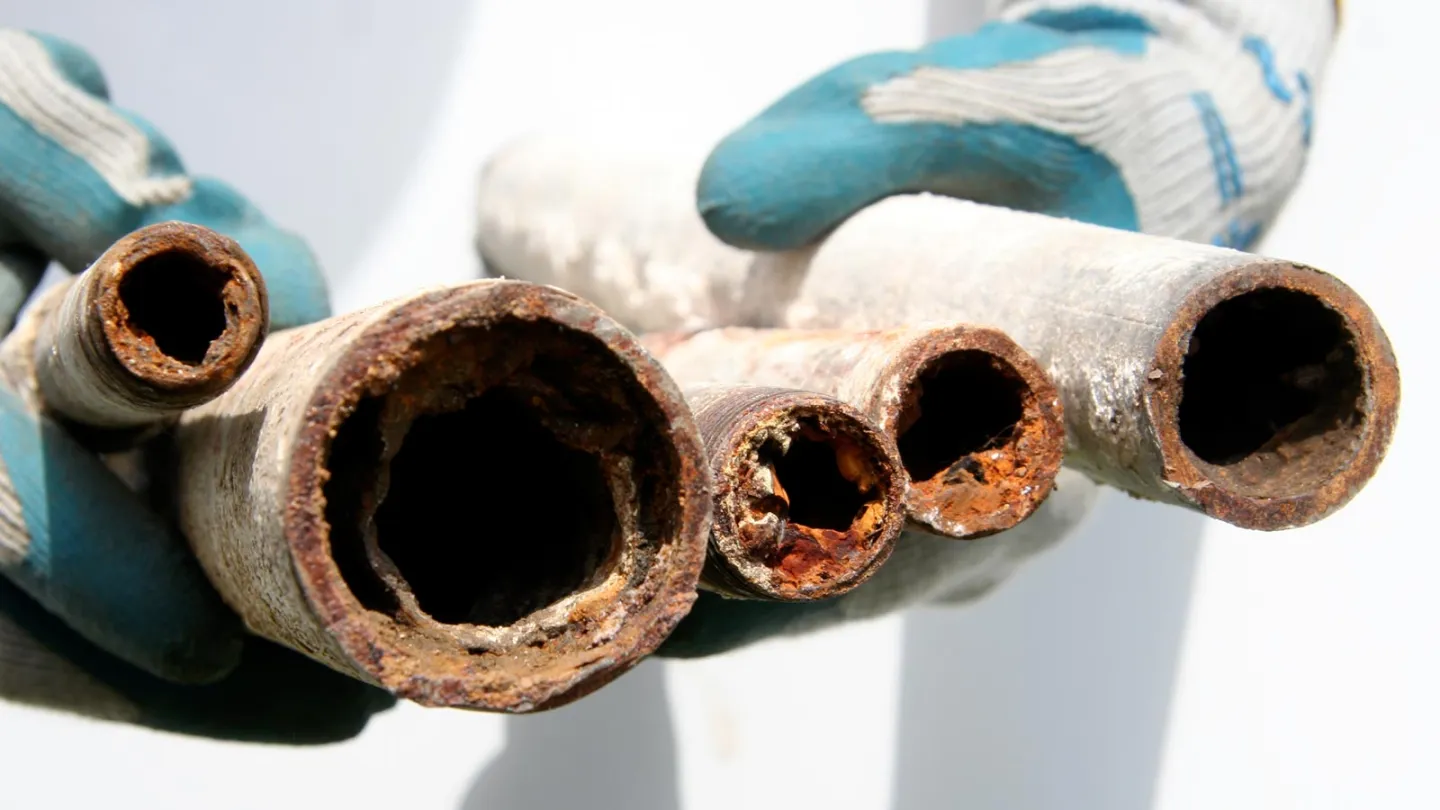
Water is one of those everyday essentials that rarely gets much attention until something starts going wrong. A faucet develops a chalky ring. The showerhead stops spraying properly. Your coffee tastes a little strange. Maybe the water heater isn’t performing like it used to.
None of these problems usually appears out of nowhere.
Water carries naturally occurring minerals and, depending on its source, may also contain sediment or other substances. As water moves through pipes, appliances, and fixtures, those materials can leave deposits behind or affect the way water looks, smells, tastes, or behaves.
The good news is that understanding the cause often makes the solution much simpler. You don’t need to treat every possible water issue with the same system. Start with the problem in front of you, learn what’s causing it, and then choose treatment accordingly.
Why Scale Appears in Your Home
If you’ve ever scrubbed a white, crusty deposit from a faucet, you’ve seen scale.
Hard water contains minerals such as calcium and magnesium. When water evaporates from a surface, these minerals can remain behind. Heating the water can also encourage deposits to form, which is why water heaters, kettles, dishwashers, and coffee machines often show the effects.
Over time, scale buildup can become more than an eyesore. Deposits may restrict openings, interfere with heating surfaces, and make appliances harder to maintain.
The severity depends on your water chemistry and how much water your household uses. A home with mildly hard water may experience only occasional spotting, while another property can struggle with persistent deposits everywhere.
Hard Water Isn’t the Same as Dirty Water
This distinction is worth making because the terms often get mixed together.
Hard water is primarily about mineral content. It doesn’t automatically mean the water is contaminated or unsafe.
Calcium and magnesium are naturally occurring minerals, and their presence is not unusual. The concern is often practical: scale, soap performance, cleaning, and equipment maintenance.
A water softener can address hardness by reducing certain minerals, but it isn’t designed to remove every substance that might be present in water.
That’s why knowing the difference between hardness and contamination is important before buying equipment.
Water Quality Can Change Over Time
Even if your water has always been fine, conditions can change.
Municipal water sources can vary seasonally. Construction or plumbing work can disturb sediment. Private wells may experience changes after heavy rainfall, flooding, drought, or shifts in groundwater conditions.
A sudden change in color, smell, or taste shouldn’t simply be ignored.
If something seems different, investigate it. Sometimes the cause is harmless and temporary. Other times, testing may reveal an issue that needs attention.
For private well owners in particular, regular testing can provide useful information about changes that aren’t obvious just by looking at the water.
What About Contaminants?
Water can contain a wide range of substances, and the word “contaminant” covers many different things.
Some substances affect taste or appearance. Others may create problems for plumbing or appliances. Certain contaminants can present genuine health concerns depending on what they are and how much is present.
The important thing is not to assume that every filter removes everything.
Different technologies target different problems. Activated carbon filters, for example, can reduce chlorine and certain organic compounds. Sediment filters capture physical particles. Reverse osmosis can reduce many dissolved substances. Water softeners focus mainly on hardness minerals.
If testing identifies specific contaminants, choose a treatment method that has been designed and verified for those substances.
A big, expensive filtration system isn’t automatically better if it isn’t suited to the problem.
Why Flow Matters More Than People Think
A filter can have excellent specifications and still be a poor choice if it can’t keep up with your home’s demand.
Imagine turning on a shower while someone starts the washing machine and another person fills the bathtub. Suddenly, the treatment system has a much bigger job to do.
This is why water flow matters when choosing whole-house treatment.
Flow rate is usually measured in gallons per minute or another comparable unit. The system needs to provide adequate treated water without creating excessive pressure loss.
For a small household, the requirements may be modest. Larger families or commercial properties can have much higher peak demand.
Average daily usage is useful, but peak demand is what can expose an undersized system.
Choosing Between Filtration and Softening
A common mistake is assuming that one system can solve every water issue.
If your primary concern is mineral scale, a softener may be appropriate. If you’re worried about chlorine taste, carbon filtration could make more sense. If testing reveals a particular dissolved contaminant, a specialized treatment system may be necessary.
Sometimes a combination is the best approach.
For example, a home might use sediment filtration to protect downstream equipment, a softener to address hardness, and a point-of-use filter for drinking water.
That sounds complicated, but a properly designed system can actually simplify things by giving each treatment stage a clear job.
Don’t Buy Based on Marketing Alone
Water treatment products often come with impressive-sounding descriptions.
“Advanced purification.” “Ultra-filtration.” “Next-generation technology.”
These phrases aren’t necessarily meaningless, but they don’t tell you enough by themselves.
Look for specific information about what the system is designed to remove or reduce. Check available certifications and performance data. Ask how the system behaves at different flow rates and what maintenance is required.
A trustworthy provider should be comfortable answering straightforward questions.
If someone tells you that a single system removes “everything,” ask for specifics. Water chemistry is too complicated for vague promises.
Maintenance Is Part of Water Treatment
Installing a system is only the beginning.
Filters need replacement. Softener systems require routine attention. Reverse osmosis membranes eventually need changing. Tanks, valves, pumps, and other components may also need inspection.
Ignoring maintenance can reduce performance and shorten equipment life.
Before purchasing, ask about replacement schedules and costs. Find out whether filters are readily available and whether routine service can be handled locally.
It can be tempting to focus entirely on the initial purchase price. But water treatment is a long-term expense, and maintenance can make up a meaningful part of that cost.
Protecting Your Appliances
Water treatment isn’t only about making tap water taste better.
If hard water is causing significant scaling, reducing hardness may help protect equipment that regularly heats or uses water. Coffee machines, dishwashers, water heaters, washing machines, and other appliances can all be affected by mineral deposits.
That doesn’t mean treatment will make appliances last forever. Regular cleaning and maintenance still matter.
But reducing avoidable buildup can make ownership easier and potentially reduce some maintenance demands over time.
When Professional Help Makes Sense
Some water problems are simple enough to handle with a basic filter. Others are not.
If you notice persistent discoloration, unusual odors, recurring scale, or other changes, professional water testing can help identify what’s happening.
For well water, more comprehensive testing may be especially important. If a test reveals a specific contaminant, it’s worth choosing treatment based on the test results rather than guessing.
A good water-treatment professional should explain the findings in plain language and show how the recommended equipment addresses them.
You shouldn’t need an advanced chemistry degree to understand what you’re buying.
A Smarter Way to Improve Water Quality
The best water-treatment decisions usually begin with curiosity rather than panic.
Look at the signs your water is giving you. Test when appropriate. Understand the difference between hardness, sediment, dissolved substances, and other water-quality concerns.
Then choose equipment that solves the problem you actually have.
There’s no reason to install an elaborate system simply because it has more stages or a longer list of features. Likewise, choosing the cheapest filter available isn’t always a smart saving if it doesn’t perform adequately.
Good water treatment is about balance.
The right system should provide the quality you need, handle your household’s demand, fit your budget, and remain practical to maintain.
Once that’s achieved, the benefits are wonderfully ordinary: cleaner fixtures, better-tasting water, fewer frustrating deposits, and appliances that aren’t fighting an unnecessary battle every day.
Sometimes the best sign of a successful water-treatment system is that you stop thinking about it altogether. You turn on the tap, fill the glass, and get on with your day.