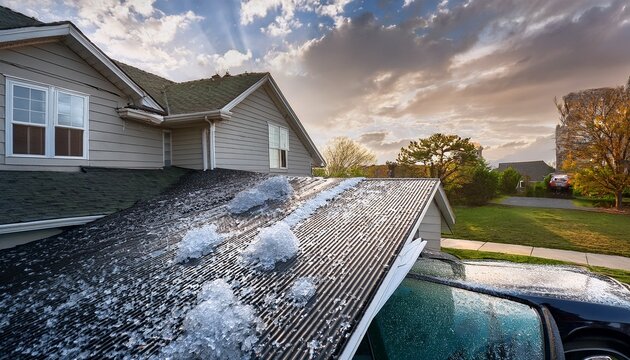
After a Calgary hailstorm, the roof gets the attention. The walls, frames and gutters often carry just as much damage.
Here is the pattern after nearly every hailstorm. The homeowner climbs a ladder or hires someone to look at the roof, files a claim for the shingles, and stops there. The siding, the window frames and the eavestroughs never get a second look.
Hail does not fall straight down. In the Calgary hail corridor, storms often come with wind, and the stones hit walls at an angle. That means the west and south faces of your house can take as much punishment as the roof. This article walks through what to look for on each part of the exterior, how to document it, and how adjusters tend to read it.
Why the walls get hit too
A hailstone carries its energy in the direction it travels. In a wind-driven storm, that direction is sideways. Your siding, window frames and eavestroughs are in the line of fire.
Walls also hide damage better than roofs do. A dent in vinyl is easy to miss from the lawn. A crack in a fibre-cement board may sit under a shadow line. A bent eavestrough looks fine from the street.
Damage on the walls tells you something about the storm. If the roof shows hits only on one slope and the siding shows matching marks on the same side, you have a clear picture of the storm’s direction. That matters for how the claim is read.
What hail does to siding
On vinyl, look for cracks, splits and small round holes. Vinyl gets brittle in the cold, so a fall or early winter storm can crack it more readily. Check around the lower edge of each panel, where the lock meets the panel below.
On fibre-cement, look for chips at the surface, cracked corners and fine lines that spread from an impact point. These can let water behind the board. They do not always show on the face of the paint.
On wood, look for bruises and dents in the grain. Hail can break the paint film, and bare wood under the crack will take on water through the winter.
On stucco, look for pitting and spalling, where small chunks break off the surface. Stucco hit by hail may also develop hairline cracks that open up over the following freeze-thaw cycles.
On metal siding, look for dents and a loss of the factory finish. Dents may be cosmetic, but a chipped coating can lead to rust.
Window frames, screens and sills
Windows are where hail damage turns into water damage. The glass itself usually survives. The frame, the sill and the screen often do not.
Check the exterior frame for dents, chips and cracked caulk. Vinyl frames can crack at the corners. Aluminum clad frames can show dents and finish damage. Wood frames may show bruised paint that exposes the grain.
Look at the caulk line where the window meets the wall. Hail impact can crack the sealant. A cracked seal is an open door for water, and the water travels into the wall cavity where you cannot see it.
Also check the window screens. They are cheap to replace, but they are a handy marker. A torn or dented screen on a given wall tells you how hard that wall was hit.
Eavestroughs and downspouts
Eavestroughs are thin metal and show hail damage clearly, if you know where to look. Walk the line and check the top edge and the outer face. Dents on the outer face are common. Dents that change the shape of the trough matter more.
A crushed or bent section can pool water. Pooled water freezes in a Calgary winter and pulls the trough off the fascia, which is the board the trough hangs from. Downspouts can crush at bends, which blocks flow.
Check the end caps, the corners and the seams. Hail can open a seam that was already getting tired. That kind of damage tends to show itself as a drip line on the siding after the next rain.
How to document it before anyone arrives
Start with photos from the ground in daylight, one wall at a time. Take a wide shot, then close shots of each damaged area. Put a coin or a tape measure in some shots to show scale.
Mark what you find. Chalk works on some surfaces. A small piece of painter’s tape beside each hit is cleaner. Write down which wall and which window or section each photo belongs to.
Keep a record of the date of the storm and the time you saw the damage. Save any weather alerts from your phone. If a neighbour’s property shows the same pattern, note that too.
- Photograph every wall, even the ones that look fine.
- Shoot each window frame close up, including the caulk line.
- Walk every eavestrough run and shoot the dents and the seams.
- Keep damaged screens or pieces rather than throwing them out.
- Do not wash, paint or patch anything until the claim is settled.
Temporary protection is fine and expected. If a window frame is cracked, covering it with a tarp or sealing the gap stops further damage. Keep the receipts and photograph the work.
How adjusters tend to look at it
An adjuster walks the property, checks the damage against the policy, and decides what is covered. They are looking for storm damage, not wear and age. That distinction matters.
Old damage and new damage can look similar. A chip that has weathered for years looks different from a fresh impact with bare, clean edges. Your photos from the days right after the storm help show which is which.
Adjusters also tend to focus on the roof because it is the larger line item. If you do not point out the walls and eavestroughs, they may not get a full review. Ask directly that every exterior surface be inspected, and walk the adjuster around the house.
Policies differ on cosmetic damage. Some cover dents in metal only when function is affected. Read your own policy, and ask your insurer what it says. We are a contractor, not an adjuster, so treat what your insurer tells you as the final word on coverage.
Soffit, fascia and the details people skip
Soffit is the panel under the roof overhang. Fascia is the board the eavestrough hangs from. Both sit high, so nobody looks at them closely from the ground.
Hail can crack vented soffit panels and knock the paint off fascia. A cracked soffit panel lets rain, snow and pests into the attic space. Bare fascia wood soaks up water and starts to rot by spring.
Walk the perimeter slowly and look up. Binoculars help. Check for holes, cracks, missing panels and paint that has chipped away in a round pattern.
Also look at wall vents, light fixtures and gas meter covers. They are small, but they are often the first things hail breaks, and they can let moisture straight into the wall.
Why a whole-exterior inspection beats a roof-only one
A roof-only inspection finds roof damage. That sounds obvious, but it explains why so many claims close without the walls ever being reviewed. Someone looks at what they were asked to look at.
A whole-exterior inspection covers the roof, siding, windows, soffit and fascia, and eavestroughs in one pass. The same person sees how the damage connects. A bent eavestrough may explain a wet stain on the siding below it. A cracked window caulk line may explain the damp patch inside.
It also helps with sequencing. If the roof, the eavestroughs and the siding all need work, the order matters. The roof edge, the trough and the wall flashing meet at the same spot. Doing them separately, by different crews, is how gaps and leaks appear.
Check all four sides, not just the top
The roof is the biggest single repair after hail, but it is not the only one. Walls, window frames and eavestroughs can carry a large part of the damage, and they are the parts most likely to be left out.
If your roof took hits too, the hail damage roof restoration in Calgary page explains what the roof side of that repair involves. Walk the rest of the house yourself first, so the whole picture is in front of you when the adjuster arrives.
Photograph early, keep the pieces, and ask for every surface to be inspected. A claim built on the whole exterior is harder to dispute and far less likely to leave you with a second repair bill next year.
About the author: this article was contributed by the team at JM Contracting, a Calgary exterior and building-envelope contractor serving the city since 1999. Its Red Seal journeymen work across siding, stucco, windows, soffit and fascia, eavestrough, painting, roofing and insulation.
Leave a Reply