
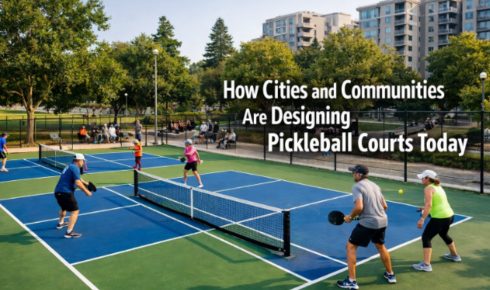
Pickleball has rapidly evolved from a recreational activity into a mainstream sport embraced by cities, housing societies, and community parks. With growing participation across age groups, municipalities and planners are paying closer attention to how pickleball courts are designed. From layout planning to surface selection, modern pickleball court construction focuses on accessibility, safety, durability, and efficient use of space.
This article explores how cities and communities are designing pickleball courts today, with a focus on flooring choices, dimensions, materials, and long-term usability.
The Growing Demand for Community Pickleball Courts
Pickleball’s appeal lies in its simplicity, social nature, and low barrier to entry. As participation grows, cities are increasingly integrating pickleball courts into public parks, recreation centers, and residential developments.
Community planners aim to create courts that:
- Accommodate players of all ages
- Support frequent daily use
- Require minimal maintenance
- Fit within limited urban spaces
These goals have shaped how pickleball court flooring and overall court design are approached in modern developments.
Importance of Proper Pickleball Court Design
A well-designed pickleball court enhances player experience while minimizing conflicts in shared spaces. Poor planning can lead to surface wear, safety concerns, and underutilized facilities.
Modern pickleball court construction emphasizes:
- Clear court orientation
- Proper spacing between courts
- Consistent playing surfaces
- Noise and impact management in residential areas
Designing with long-term use in mind ensures that courts remain functional and welcoming for the community.
Standard Pickleball Court Dimensions and Layout
Maintaining correct pickleball court dimensions is essential for fair play and user satisfaction. A standard pickleball court measures 13.41 meters in length and 6.10 meters in width, including the non-volley zone.
Cities often design multiple courts side by side to maximize space efficiency. Accurate dimensions and proper spacing between courts help prevent overcrowding and allow safe player movement.
During planning, surface leveling and line placement are carefully coordinated to ensure that all courts perform consistently.
Selection of Pickleball Court Material
The choice of pickleball court material plays a key role in how the court performs and how long it lasts. Traditional surfaces such as concrete or asphalt are still used as base layers, but surface coatings and finishes have evolved significantly.
Modern community courts prioritize materials that offer:
- Predictable ball bounce
- Reliable foot traction
- Resistance to weather and wear
- Low maintenance requirements
These needs have led to wider adoption of advanced surface systems rather than bare concrete finishes.
Rise of Synthetic Pickleball Court Flooring
One of the most notable trends in community court design is the growing use of synthetic pickleball court flooring. These systems are designed to enhance playability while improving durability and safety.
Synthetic pickleball court flooring typically offers:
- Uniform surface texture
- Controlled grip for quick movement
- Improved comfort during extended play
- Consistent performance across the court
Because of these benefits, synthetic surfaces are increasingly preferred for public and residential projects.
Player Safety and Surface Comfort
Community pickleball courts serve a wide range of players, including seniors and beginners. Safety is therefore a primary consideration in court design.
Modern pickleball court flooring systems are selected to reduce slip risk and help absorb impact from repeated movement. Synthetic surfaces, when properly installed, provide a balanced level of firmness and cushioning, supporting safer play without affecting game speed.
This focus on comfort encourages longer play sessions and broader community participation.
Designing for Multi-Use Community Spaces
Urban areas often require sports facilities to serve multiple purposes. Many cities design pickleball courts that can coexist with other recreational activities.
Thoughtful pickleball court construction considers:
- Compatibility with multi-sport layouts
- Efficient use of available land
- Clear line markings for different activities
- Flexible surface systems
Synthetic flooring solutions adapt well to these requirements, making them suitable for shared community spaces.
Durability and Maintenance Considerations
Public courts experience heavy use, making durability a critical factor in design decisions. Cities aim to minimize repair costs and downtime through smart material selection.
Synthetic pickleball court flooring is valued for its resistance to surface wear and fading. Seamless surfaces simplify cleaning and reduce the likelihood of cracks or uneven patches that can affect play.
Lower maintenance demands allow municipalities to allocate resources more efficiently while keeping courts in good condition.
Environmental and Climate Considerations
Climate plays an important role in court design. Outdoor pickleball courts must withstand temperature variations, moisture, and prolonged exposure to sunlight.
Modern pickleball court flooring systems are designed to perform reliably under these conditions. Synthetic materials are often chosen for their ability to maintain texture and color despite environmental exposure, supporting long-term usability in public spaces.
Community Engagement and Inclusive Design
Cities increasingly involve communities in the planning process. Inclusive design ensures that pickleball courts meet the needs of local users, from casual players to organized groups.
Well-planned pickleball courts encourage social interaction, physical activity, and community engagement. Features such as clear signage, seating areas, and accessible pathways complement the court surface and enhance overall usability.
Conclusion
Cities and communities are rethinking how pickleball courts are designed to meet growing demand and diverse user needs. From maintaining accurate pickleball court dimensions to selecting durable pickleball court material, modern pickleball court construction focuses on performance, safety, and sustainability.
The increasing adoption of synthetic pickleball court flooring reflects a shift toward surfaces that support long-term use, reduced maintenance, and improved player experience. As pickleball continues to expand in popularity, thoughtful court design will remain essential in creating inclusive and resilient community sports spaces.