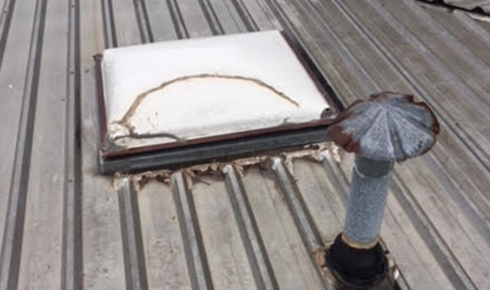
Why curb detailing, condensation control, and code-required smoke and heat vents make rooftop openings the most demanding penetrations on a commercial roof.
Every opening cut into a commercial roof is a deliberate hole in the waterproofing, and skylights and smoke vents are the biggest holes most roofs have. They bring real value: daylighting cuts lighting costs and improves the space below, and code-required smoke and heat vents are a life-safety necessity in many buildings. But each one is a penetration the membrane has to be sealed around, and on a low-slope roof, where water sits and moves slowly, a poorly detailed rooftop opening is one of the most reliable ways to put water inside a building.
The good news is that leaking skylights and vents are almost always a detailing failure, not an inherent flaw in the products. The curb the unit sits on, the flashing that ties the curb into the membrane, and the condensation control inside the assembly are what decide whether a rooftop opening stays dry for decades or drips within a year. This piece covers how to detail these penetrations properly on a low-slope roof, why condensation is as much a threat as rain, and where the building code requires smoke and heat vents in the first place.
The curb is everything
A skylight or smoke vent on a low-slope roof should sit on a curb, a raised frame that lifts the unit above the roof plane so water flowing or ponding across the membrane can’t reach the opening. The curb is the single most important detail in keeping a rooftop penetration dry, and its height is not arbitrary: industry practice puts it high enough, typically eight inches above the finished roof, that water and accumulated snow can’t back up over the top of the flashing.
Mounting a skylight or vent flush on the membrane plane is asking for trouble. With no height to keep water away from the opening, any ponding, snowmelt, or driving rain that crosses the membrane reaches the unit’s base, and the only thing between that water and the interior is a bead of sealant. Sealant fails. A proper curb means the waterproofing, not the caulk, keeps the water out. The curb also has to be structurally sound and integrated with the framing, because it carries the unit and takes wind load, and on a smoke vent it is part of a unit that has to open reliably in a fire.
Flashing the opening into the membrane
With the curb in place, the membrane has to be carried up and over it so the waterproofing is continuous from the field, up the curb side, and onto the top where the unit’s flashing takes over. This base flashing has to be fully adhered to the curb, run high enough to stay above any water, and terminated under a counter-flashing or the unit’s flange so water sheds over it rather than behind it.
The lap directions are what make it work. Water always has to run over the top of each layer, never behind it, so the unit’s flange or counter-flashing overlaps the base flashing, which overlaps the field membrane. Reverse any of those laps and the detail funnels water straight into the assembly, the kind of thing that looks fine from the ground and leaks at the first real rain. Corners are the hard part, where the membrane has to transition in two directions at once. Pre-formed or carefully fabricated membrane corners, fully sealed, are what hold up; field-cut corners patched with sealant are where curb flashings fail first.
Condensation: the leak that isn’t rain
Not every drip under a skylight is a leak. In Calgary’s climate, condensation is a major and often misdiagnosed source of water around rooftop openings. Skylights are thermal weak points: glazing and metal frames conduct cold far better than the roof around them, so in winter the inside surfaces run cold, warm humid air contacts them, and water condenses and drips. The owner sees water and assumes the skylight leaks, when the assembly is doing it from the inside.
Good skylight units fight this with thermally broken frames that interrupt the cold metal path, insulated glazing, and condensation gutters that catch the water that does form and channel it back outside. Specifying a unit designed for cold climates, rather than the cheapest available, keeps condensation from masquerading as a leak every winter. The surrounding detail matters too: a continuous air and vapour barrier tied into the curb keeps warm, moist interior air from reaching the cold parts of the assembly, which is the real cure. Controlling the air movement is as important as controlling the rain.
Code-required smoke and heat vents
Smoke and heat vents aren’t an architectural choice; in many buildings the code requires them. They open in a fire to let smoke and hot gases escape upward, which keeps the smoke layer higher for longer, improves visibility for occupants getting out, and helps firefighters work the building. The Alberta Building Code and the fire code call for them in specific building types and configurations.
Where they’re required tends to track large, open, single-storey buildings with significant fire load: warehouses, big-box retail, manufacturing and storage occupancies above certain sizes. The exact triggers depend on building area, use, height, and sprinklers, and the code consultant determines the requirement for a given project. The point for an owner is that on these buildings the vents are a life-safety code requirement, not optional equipment to value-engineer away.
Because they’re life-safety devices, smoke vents have to work when called, which puts a maintenance obligation on the owner. The opening mechanisms, whether fusible links or other release systems, have to be tested so the vent opens in a real fire. A vent that’s been painted over, corroded shut, or never tested won’t perform when it’s needed, which is both a safety failure and a liability.
Daylighting done right
Beyond code-required vents, skylights and tubular daylighting devices are increasingly added to bring natural light into deep floor plates and cut daytime lighting costs. On a warehouse or big-box space, well-placed daylighting can substantially reduce electric lighting load during daylight hours. But every device added is another penetration, and the benefit only holds if those penetrations stay dry.
- Use prismatic or diffusing glazing to spread daylight evenly rather than dumping a bright beam on one area.
- Specify impact-rated glazing in Calgary’s hail corridor so a severe storm doesn’t shatter the units.
- Balance daylighting against winter heat loss, since glazing insulates far worse than the roof it replaces.
- Pair daylighting with photocell controls that dim or switch the electric lights, or the energy benefit never materializes.
- Detail and curb every unit to the same standard as any rooftop penetration, because more openings mean more chances to leak.
Daylighting pays off when the glazing is chosen for the climate, the controls capture the lighting savings, and every unit is curbed and flashed properly. Added carelessly, a dozen new skylights are just a dozen new leak risks with a hail target on each one.
Maintaining rooftop openings
Skylights and vents belong on the maintenance walk, because they’re the spots most likely to develop a problem. An inspection checks the curb flashing for lifting or failed sealant, the glazing for cracks, the condensation gutters for blockage, and, on smoke vents, the operating mechanism. Catching a tired sealant joint or a cracked pane early is far cheaper than chasing the interior damage it causes later.
Calgary’s hail and freeze-thaw cycling make this recurring. Hail crazes glazing, freeze-thaw works at every sealed joint, and UV degrades gaskets and sealants over the years. A penetration that was watertight at install needs periodic confirmation that it still is, especially after a major hailstorm. A commercial roofing contractor that details and maintains rooftop penetrations keeps the openings doing their jobs without becoming the roof’s weak point.
Detail the hole, keep the building dry
Skylights, smoke vents, and daylighting devices earn their place on a commercial roof, bringing light, code-required life safety, and lower lighting bills. But each one is a hole in the waterproofing, and on a low-slope roof the difference between a hole that stays dry for decades and one that drips within a year comes down to detailing: a proper curb that lifts the opening above the water, flashing lapped so water always sheds over it, condensation control that handles Calgary winters, and impact-rated glazing for the hail.
Smoke and heat vents carry an added duty, since the code requires them in many buildings and they have to work when called, which makes their maintenance non-negotiable. Detail every rooftop opening to the same high standard, keep them on the inspection walk, and check them after every major storm. Work with a Calgary flat-roofing team that treats penetrations as the demanding details they are, and the openings that bring light and safety into the building never become the reason it leaks.
About the author — this article was contributed by the team at Superior Roofing Ltd., a Calgary commercial roofing contractor with 25+ years of experience and Red Seal Journeymen on staff. The team details and flashes skylights, smoke and heat vents, and daylighting devices on low-slope roofs across Alberta, and carries $10 million in liability coverage.
